Search This Blog

Thursday, August 12, 2010

Polymer Penny Pinching

On a recent poll on our forum, I asked the community about tools of the trade - specifically price and polymer clay. 88% of us said that we're open minded about what tools we use in our clay crafts. Or, as one member said, we can see potential in anything.

As a polymer clayer, I whole heartily agree with her. Tools come in all shapes and sizes - from leaves and rocks to olive jars. Often enough, there's no need to part with money to achieve a beautiful clay piece.

Stamps
Molds and stamps are particularly expensive, and while they are sometimes irreplaceable, there are a number of every day objects and found items that can be used instead. The clay and crystal leaves below were stamped with leaves from the garden.
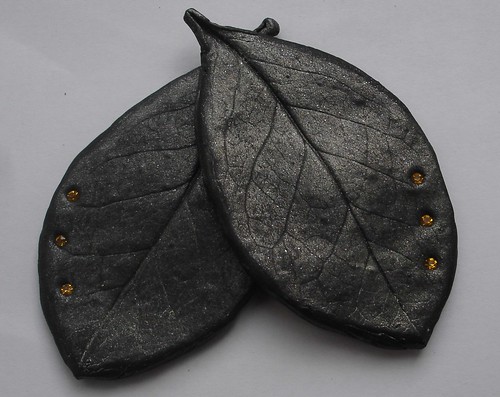


Using natural objects as molds or presses in your clay work can lend an organic feel to your pieces. The leaves above have subtle and soft details - something I might not have achieved with a manufactured stamp.


Below is another example of how clay artists can use readily available objects for texture and impressions. This pendant, made of black Fimo, was shaped and stamped with a natural stone. The porous surface of the stone created a beautiful and unique texture. The curvy impression was made with wire.


Other Tools
There's more to working with clay than the finishing touches. One of the most time consuming and exhausting parts of polymer clay is conditioning. For years I thought a pasta machine was vital to condition clay, and the price of one was off putting. Now, these and other tools have dropped in price and are not a huge investment for hobbyists.

There are still alternatives to things like pasta machines, like old fashioned elbow grease. Personally, I use a long glass jar, but you can easily use a sturdy roll of cling film. If you're a die-hard DIY fan, then you might consider buying your own acrylic tubing and having rolling pins in a variety of sizes.

Not Always about £
Unconventional tools allow for flexibility, subtlety, and can create beautiful clay art. They also allow you to practice before making larger investments into the hobby. Once you've found your niche in clay, you can always opt to pay for tools that make your work easier or faster. No matter how advanced we might become in the use of polymer clay, I think there will always be a place for the creativity and beauty that using natural and basic tools gives us.


Wednesday, May 19, 2010

Sterling Silver - just a few little tips for checking it's real

I'm sure many of you have probably found yourself in the same situation as me, but for those out there who are yet to experience the exasperation of sterling silver  - that turns out not to actually be sterling silver I'd like to share a few little tips. Whether you are given something by a family member or friend, or buy from a seller you are not 100% sure of it's always worth making a few quick and easy checks especially if you are planning on selling your items on.

1. Not all items described or even stamped as Sterling silver 925 are silver, and sometimes items will contain parts that are silver and parts that aren't! Sometimes this is a deliberate ploy to part you from more money, sometimes just a genuine mistake, but always annoying. I once found that only the tag on a necklace which  I had always believed was sterling actually was - all the other parts were very magnetic!

2. Check the items as soon as possible - I just checked some items that I've had in my stash for over 5 years only to find out they weren't SS and I had paid around £8 for something that was worth no more than a couple of pounds at best. If back then I had carried out a simple test I would have been able to ask for a refund. Now I'll just have to put them to a different use.

3. Get out a strong magnet - sterling silver is not magnetic - if your items leap to the magnet like mine did they aren't SS. Not all base metals are magnetic, so while the magnet test will tell you items they definitely aren't SS, you may still want to check further if you are still suspicious.

3b.  Be careful if you try to use a magnet to check clasps! The springs in lobster and bolt ring clasps can't be made from sterling silver as it is a soft metal, and a strong magnet will often attract sterling silver clasps. When carefully trying it against the loop parts of these claps I have seen that they aren't magnetic, but on such small findings, it's not a good testing method!

4. Still not sure, not got a magnet handy? Take the sniff test! Wash your hands with a mild soap, so they are nice and clean and dry them thoroughly. Hold the silver items between your palms till your hands have thoroughly warmed the metal up, then sniff your palms. If they smell distinctly like copper coins it is very likely that your items are actually silver plated on a copper base.

5. Silver testing kits. If you are buying a larger item, or likely to be buying a lot of SS you may want to consider investing in a silver testing kit, however people have differing success reading the results and you have to be careful not to damage the items you are testing. Some jewellers may also offer this service, but generally for jewellery findings and beads this isn't a very practical solution.

I'm sure there are there are other good tips out there to help in identifying items that aren't actually sterling silver (that don't involve damaging the item to check), so if you have a tip to share, please do post a comment to let us all know.

Happy beading

Saturday, May 08, 2010

Spring cleaning your creativity

This spring several things have prompted me to consider the fact that I've been feeling somewhat underwhelmed and disenchanted when it comes to beading. That's not to say that I've lost my love of beads and beading, but I realised that there are things that I have been allowing to hold me back and drain my creativity.

I've come to realise that there is a point where in place of the enjoyment of making or collecting things you love you feel bogged down by an over sized collection of items you've hoarded.

It feels hard to let go of the past but there are beads, techniques and styles I'm no longer interested in. Pieces that I can now see no longer live up to the quality I expect to achieve in my work. Looking at my bead collection it sometimes felt like I "couldn't see the wood for the trees" and was drowning in a sea of beads.

Taking the time to completely go through my bead stash and remove the items I know I won't miss at all (and some that I'll only miss a little) has been truly liberating. Reorganizing all those half finished (or only just started) projects into a system where they can be seen, and not forgotten, invites me to work on them.

But I'm now facing the same trial with my jewellery. I fear this is going to be a lot harder. Knowing that I must dismantle, sell cheaply or give away those pieces that are not my best, feels like erasing history. Though I will have photos and memories to keep it is still hard to recognise and accept that my beading has moved on and so must I. Continuing to keep or offer for sale items that don't show me at my best is guaranteed to destroy both my creativity and sense of worth.

The past should be a platform to launch ourselves from not an anchor to keep us in place and stop us from exploring new directions.

I know that I am the only one holding myself back and that to free my own creativity I need to allow myself a fresh start.

So here's to spring cleaning your creativity! I hope that you to will take a moment to ponder on the wonders of springtime, and let your creativity grow like a flower in the sun.
 

British Bead Awards 2010

Are you entering the British Bead Awards this year? Last year's competition was the first of it's kind and a great step forward in recognizing the amazing talent that we have here in the UK! Three members of the UK Beaders forum took home awards; Kerrie Slade came joint 2nd in the Seed Bead category with her beautiful Maid Marian's Quiver, Julie Fountain came 1st in the Other Finished Beadwork category with her Dazzle Silver Core Pendant, while Lynn Davy won an impressive three times including 1st place in the Crystals catergory with Fading Beauty.

There's still time to enter your masterpiece into the British Bead Awards 2010, the deadline is Friday July 2nd and you can download the entry form here as well as view the competition rules and a complete list of last year's winners. And for everyone that's entering, best of luck!

Thursday, May 06, 2010

A new beginning and purpose for the UK Beaders Blog!

Hello everyone.

As you can see it's been rather a long time since I lasted posted to this blog! Indeed our forum is now celebrating it's 4th anniversary and we are expecting our 2,500th member to join up any day now - will it be you?

With so much going on in the UK Beaders community these days, and so many wonderful blogs that our members (and other great creative people) are writing, I realised it was time that we revived our long abandoned blog and brought it back to life as as the UK Beaders community blog. A place where our community members can post together to bring you a wide range or posts on all sorts of things about and of interest to us beaders and jewellery makers.

So if you are a member of our forum you may have already seen that we are inviting any interested members to join in writing this blog, and share their beady thought with us here too.